백담사에서는
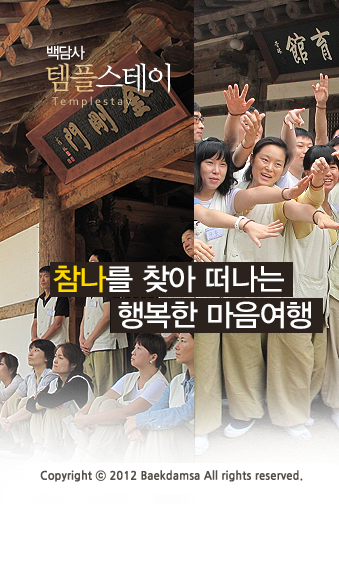
지난 11월 10일 ~11일 1박 2일동안 IRP 주관의 미국 주요 언론인들과 템플스테이를 가졌습니다. 그 때 참여했던 Kansas City Star지의 Randy Smith 편집장이 쓴 기사입니다.

백담사에 들어서면서 본 수많은 돌탑이 인상적이었다는 얘기부터
백담사의 가을 정경, 만해 한용운 스님, 무설전과 사물에 대해서의 느낌과 감상을 적었고
청규 및 마음 가짐 등의 한국 불교를 엿 볼 수 있는 내용에 대해서 간략히 기록하였습니다.
템플스테이에 참여하면서 한국 불교가 신에 의존하는 것 이상의 자아 계발에 도움이 된다는
등 한국 불교에 대해 좋은 반응을 보여서,
한국 불교의 템플스테이팀 운영자로써 뿌듯함을 느낍니다.
마지막 글에는 저녁에 만해마을에서 가진 맥주와 치킨 파티도 썼네요.^^
========================================================
Day 8: Living with Buddhist Monks
Saturday
Editor's Note: For the next two weeks, Star editor Randy Smith will be traveling with a dozen U.S. journalists in both North and South Korea. The trip, set up through the Gatekeeper Editor's program with the International Reporting Project, provides journalists with a glimpse of countries often in the news but not well covered. Look for regular updates at KansasCity.com
When you're going to stay with Buddhist monks for a few days, you start by getting up early. In our case, we had a nearly three-hour drive to Mount Sorak National Park on the eastern side of the country. It is home to Baekdamsa Temple, founded in 647.
Our early departure was good medicine: We were scheduled to get up at 3 a.m. on the next day to observe a traditional Buddhist worship service.
As we approached the temple in the afternoon sunlight, I noticed two things: First, a film crew documenting our every step. And, secondly, hundreds of neatly and individually piled stones on the banks of the river bed that you must cross before entering the Buddhist compound.
The film crew, I quickly discovered, was from the Buddhist Television Network, which planned to capture our every move for the next 36 hours. Don't be surprised to find our editor's group some late evening when sleeplessness has caused you to start flipping through the TV channels. The setting here is stunning. A dozen wooden structures, looking like they probably did 1,400 years ago, are nestled into this pine forest that is far away from the rest of the world. Autumn has turned the trees brown, but the pines are green and radiate an intoxicating smell. A famous monk once livered here, and it's the first thing that you learn. His name was Manhae Han Young-woon, and he was both a poet and a leader of the Korean independence movement against the Japanese. Your first job upon arrival is to change into traditional Buddhist garb: a pair of green quilted pants and a vest-like shirt.
Now for some rules: Have good and heartful thinking. Don't make phone calls except on permitted time. Don't be arrogant. Don't talk or laugh loudly. Obey all of the directions from the monks. If you pass by a monk, bow with folded hands. And if you enter a Buddha hall, bow to the image. And, finally, you must be polite to all, and call each other "friend" or Bubwoonim. We were put through three exercises: a tea ceremony, a blindfolded walk through the forest and a breathing exercise to teach us the power of contemplation and fermented tea. As I sat cross-legged and fumbling with the order of my tea pots, a Buddhist nun came over to help.
She told a story of two Buddhist monks who were walking along in the forest and came upon a pregnant woman who was about to deliver. One monk continued on his journey, but the other stayed to help with the baby, an action against the rules in those days. It turned out, the nun said, that the pregnant woman was actually Buddha, and the monk's actions brought him extreme holiness. The lesson, she said, is that we should always assist each other, and especially be their eyes and ears. On our walk through the woods, one partner was blind-folded and the other was not. The "seeing partner" was instructed to tell everything that he observed, painting a picture of the day and to also safely guide the other down the path.
When done, we were asked: Have you taken that much time in your life with friends and family members? Buddhism, I discovered, is more about self improvement than on relying on a deity for salvation. Much of the teaching is based on what you can do to turn your life around. I walked down to the riverbed to get some fresh air and to set up my own prayer structure, similar to the hundreds that I'd seen when we first entered the compound.
You do it by simply putting one riverbed stone on top of another. I saw some that reached three feet or more, but I was only good enough to go half that distance. The idea is to think about your life as you build. Searching for stones, I saw dozens of other visitors doing the same thing. Temple programs have grown in popularity in Korea, re-energizing the faithful and combating an onslaught of Protestant evangelism. I asked about the number of monks here, and was told there were about 50. I did not see that many, but the nun said some were living in a special houses of denial and contemplation. They receive one meal a day through a small slot in a door of an isolated room, and it goes on for months.
While some thought it sounded extreme, it's important to remember that this is a concept that stretches across many faiths. Our dinner was simple, and we were instructed to start by taking a little. There is always more, said the monk, but it's important to not eat what we do not need. Our menu: seaweed soup, rice, marinated cabbage, sliced carrots and bean sprouts.
Afterwards, we washed our serving dishes by swirling fresh water in each of our four wooden bowls. The final act was to drink the remains, which was essentially our beverage for the evening. Outside, the monks were playing four instruments in prayer.
A large, multicolored drum represented all of the living things of the world with skin. A bell, struck with a log secured by overhead chains, is for those who are in hell and need our prayerful help. A wooden fish, hung from the ceiling, is in praise of all sea creatures. And a metal cloud, hit with drum sticks, symbolizes all that fly. As the evening concluded and the Buddhist Television Network cameras were turned off, we went back to our rooms.
But we sent one of our party on a clandestine mission: Find some fried chicken.
Our happy hour was short. We had an early morning wake-up call for worship

|  | Gatekeeper Editors trip
Note: For two weeks, Star editor Randy Smith traveled to North Korea and South Korea with a dozen U.S. journalists. The trip was set up through the Gatekeeper Editor's program with the International Reporting Project at the Johns Hopkins University's School of Advanced International Studies. Contact Smith at rsmith@kcstar.com. |
출 처 : Kansas City star
http://www.kansascity.com/korea_journal/